
Search is changing. Fast.
People aren’t just typing questions into Google anymore. They’re asking ChatGPT, Perplexity, Gemini, and Copilot for answers. These AI assistants don’t just show links. They read your content, understand it, and quote it directly in their responses.
Here’s the problem: you have almost no control over how these AI tools interpret your website right now. They might pull outdated blog posts, quote the wrong pages, or completely miss your best content. That’s exactly where LLMs.txt comes in.
TL;DR: What You Need to Know
LLMs.txt is a simple text file that helps AI systems understand your website better. It acts like a guided tour for AI crawlers, showing them your most important content first.
Who needs it? Content-heavy websites, SaaS companies, knowledge bases, publishers, and any business that wants to stay visible in AI-powered search results.
Main benefits: Better AI understanding, more control over what gets quoted, and future-proofing your online presence as AI search grows.
What Is LLMs.txt?
Think of LLMs.txt as a content roadmap specifically designed for AI.
It’s a simple Markdown file that lives at the root of your website. This file tells large language models which pages matter most, where to find clean information, and how to understand your content hierarchy.
You’re probably familiar with robots.txt. That file talks to traditional search engine crawlers like Googlebot. LLMs.txt performs a comparable function, but for AI platforms. While robots.txt says, “Crawl this, don’t crawl that,” LLMs.txt says, “Here’s what matters most on our site.”
The key difference? Traditional search crawlers index everything and rank it later. AI systems need guidance upfront to give accurate, helpful answers to users.
How LLMs.txt Works
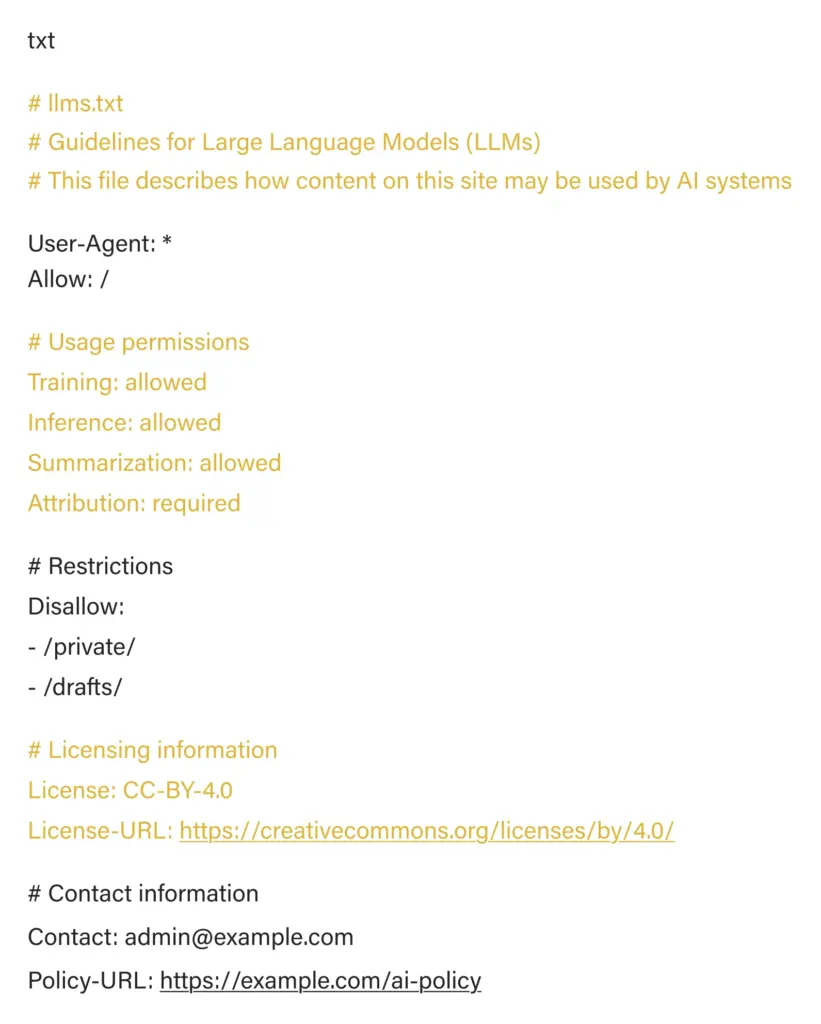
The functions are surprisingly simple.
You create a plain text file using Markdown formatting. Inside, you organize your content into clear sections with links and brief descriptions. You save it as llms.txt and upload it to your website’s root directory.
When an AI crawler visits your site, it looks for this file first. The structure helps the AI understand what content is authoritative, what’s current, and what deserves priority when generating answers.
Here’s what happens behind the scenes: AI systems use your LLMs.txt file to build context. When someone asks a question that your content can answer, the AI knows exactly where to look. It can pull from your designated pages with confidence, creating better responses for users.
This process is called retrieval-augmented generation, or RAG. Your LLMs.txt file essentially creates a curated knowledge bundle that AI systems can reference quickly and accurately.
Is this a universally adopted standard yet? No. But adoption is growing fast among AI-first tools, technical documentation sites, and forward-thinking marketers who see where search is heading.
Why LLMs.txt Matters for Digital Marketers
Let’s connect this to what actually drives business results.
Conventional SEO concentrates on securing positions within the top 10 organic results. That’s still important. But AI-powered answer engines don’t show 10 links. They synthesize one answer, often citing just two or three sources.
If your content isn’t optimized for AI discovery, you’re invisible in these new search experiences. This is where strategic SEO consultancy becomes invaluable for staying ahead.
LLMs.txt gives you three major advantages:
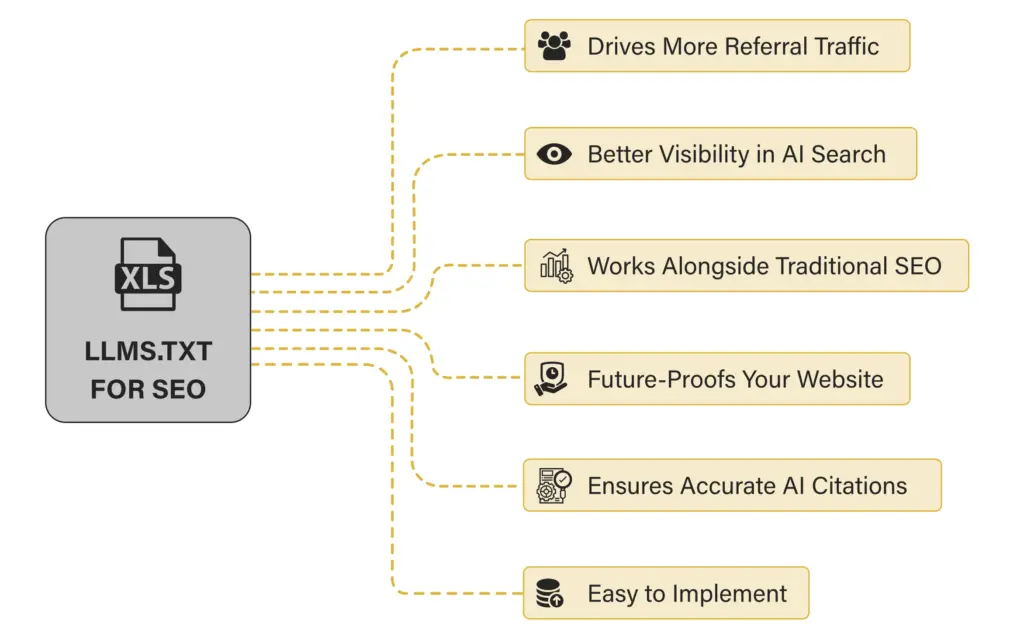
Better AI citations. When your site has clear guidance for AI systems, they’re more likely to quote your content as a trusted source. That builds brand authority and drives traffic from AI platforms.
Strategic content control. You decide which pages AI systems see first. Want them to prioritize your case studies over your old blog posts? Your LLMs.txt file makes that happen. Need to highlight product pages and FAQs? You can structure that explicitly.
Brand safety. Every website has outdated content, thin pages, or sensitive information you’d rather AI systems skip. LLMs.txt helps you steer models away from problem areas while showcasing your best work.
This isn’t about gaming the system. It’s about clear communication. You’re simply helping AI understand your site the way you want it understood.
Do You Really Need LLMs.txt?
Fair question. Let’s break this down by scenario.
You probably need it now if:
Your site is a knowledge base, documentation hub, or content library. SaaS companies with extensive help centers benefit enormously. Publishers and media sites should prioritize this. High-traffic blogs with deep archives need better AI navigation. Any brand actively thinking about AI visibility should start here.
You can wait and monitor if:
You run a small local business with just a few pages. Your site is primarily a digital brochure with basic company info. You’re an early-stage startup still figuring out your content strategy. You have limited technical resources and bigger priorities right now.
Here’s the honest truth: LLMs.txt won’t magically boost your rankings overnight. It’s not a quick fix or a ranking hack. Think of it as infrastructure for the next phase of search. You’re building the foundation now, so you’re ready when AI discovery becomes mainstream.
And that shift is happening faster than most people realize.
LLMs.txt vs LLM.txt and Other AI Files
The naming can get confusing, so let’s clarify.
LLMs.txt (with an ‘s’) is your content map. It guides AI systems to your best pages and explains your site structure. Think of it as a helpful index.
LLM.txt (without the ‘s’) and similar AI policy files focus on permissions and training rules. They tell AI systems whether they can use your content for training, what access they have, and what restrictions apply.
These files serve different purposes, but they can work together. One guides discovery; the other sets boundaries. They all work together as part of your complete technical SEO strategy.
Neither replaces your existing SEO infrastructure. Your robots.txt file still matters. Your XML sitemap is still important. Structured data markup remains valuable. LLMs.txt simply adds a new layer specifically for AI systems.
Think of your SEO stack like this: robots.txt controls crawler access, sitemaps list all your URLs, structured data adds context, and LLMs.txt provides AI-specific guidance. They all work together.
How to Create an LLMs.txt File
Ready to build one? Here’s your step-by-step process.
Step 1: Audit your content. List your most important pages. Include high-converting landing pages, authoritative blog posts, detailed product pages, comprehensive FAQs, and case studies. Focus on content that’s current, accurate, and valuable.
Step 2: Organize by priority. Group your content into sections. Try categories like Core Content (your main value propositions), Authority Signals (thought leadership and expertise), Support Resources (FAQs and help content), and Optional Resources (supplementary material).
Step 3: Create clean versions if needed. Some pages work better for AI if you create simplified Markdown versions. This isn’t always necessary, but it helps for complex pages with heavy design elements.
Step 4: Draft your file. Use simple Markdown formatting. List section headers, add links to your key pages, and include brief notes explaining what each page covers. Keep descriptions short and clear.
Step 5: Save and upload. Name your file llms.txt exactly. Upload it to your website’s root directory. Verify its public availability by accessing yoursite.com/llms.txt through a web browser.
Step 6: Maintain it. Update your LLMs.txt file when you publish major new content, restructure your site, or remove outdated pages. Treat it like living documentation, not a set-it-and-forget-it file.
If you’re using WordPress or another CMS, several plugins can help manage this process. Search for AI optimization tools or LLMs.txt generators in your platform’s plugin directory.
Best Practices and Mistakes to Avoid
Let’s cover what works and what doesn’t.
Best practices: Keep your file concise and focused. Quality beats quantity every time. Update links regularly so AI systems don’t hit dead ends. Align your structure with your business goals and brand hierarchy. Review and refresh after major site changes or content campaigns.
Common mistakes to avoid: Don’t stuff every URL into your LLMs.txt file. AI systems need curation, not exhaustive lists. Don’t create conflicts with your robots.txt file or other AI policies. Don’t block AI crawlers entirely without understanding the visibility cost. You can’t be cited if you can’t be crawled.
One more thing: be consistent. If you tell AI systems that your product pages are most important, make sure those pages are genuinely helpful and up to date. AI systems learn quickly when sites provide bad guidance.
Ready to Make Your Website AI-Ready?
LLMs.txt is optional today. But AI-powered search is becoming the norm, not the exception.
Every day, more people skip Google and go straight to ChatGPT or Perplexity for answers. Every week, more AI tools launch with built-in search capabilities. Every month, the percentage of AI-driven traffic grows.
The websites that succeed in this new landscape will be the ones that prepared early. They’ll be the sources AI systems trust and cite. They’ll be visible when their competitors aren’t. Our comprehensive SEO audit services now include AI-readiness assessment
You don’t have to tackle this alone. At Astha Technology, we help businesses optimize for both traditional search and emerging AI platforms. Our team can audit your site’s AI readiness, implement LLMs.txt correctly, and ensure you’re positioned for the future of search.
Get your free AI-readiness audit today and discover how visible your website really is to AI systems.