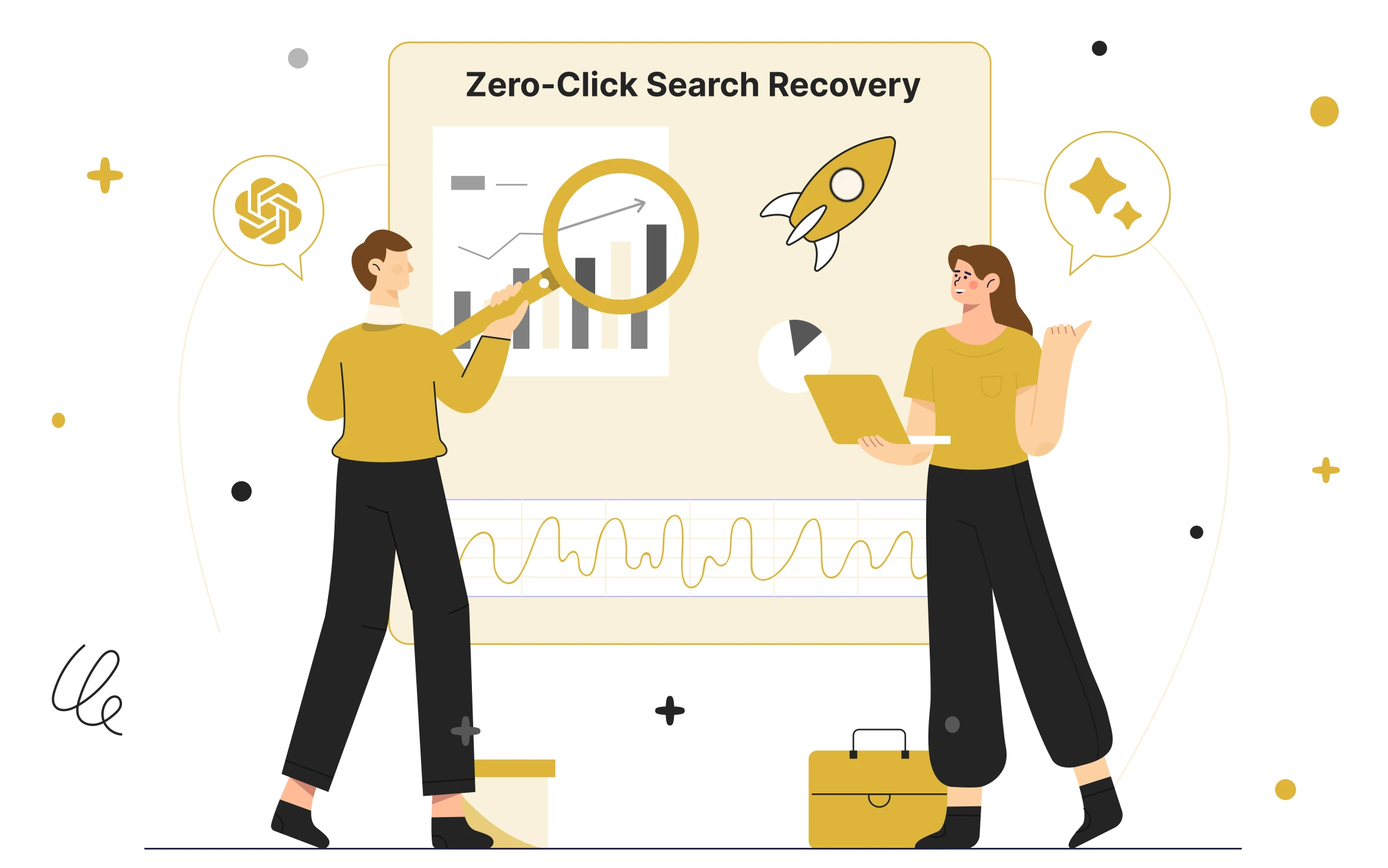
Zero-click searches now take over the digital landscape. Your content ranks first, but visitors never arrive. AI overviews, featured snippets, and chatbots answer questions without sending clicks your way.
This isn’t a temporary issue. It’s the new search reality. Understanding zero-click search recovery separates thriving businesses from those watching traffic evaporate. Let’s explore what’s happening and how to adapt.
What Is Zero-Click Search?
Zero-click search occurs when users get answers directly on search results pages. They never click through to websites. Google displays information through AI Overviews, featured snippets, knowledge panels, and instant answers.
About 60% of searches now end without a click-through. The path from product discovery to purchase increasingly happens in AI chatbots. Users find what they need and move on. Your rankings stay solid. Your traffic disappears.
The 2026 Zero-Click Crisis
The numbers tell a stark story. Organic CTR for queries with AI Overviews has plummeted by 61% since mid-2024, dropping from 1.76% to just 0.61%. Businesses can rank number one and still lose 34.5% of their clicks when AI Overviews appear.
B2B SaaS leaders report 70-80% organic traffic erosion. Publishers dependent on SEO traffic face existential challenges. Median Google referral traffic declined 10%, with losses outpacing gains two-to-one.
The “how-to guides, comparisons, and definitions” that built your traffic? AI now summarizes them instantly.
Why Traditional SEO No Longer Works
AI systems don’t rank documents. They evaluate entities, synthesize information about those entities, and choose which to cite. Keywords matter less than entity relationships.
No native AI reporting exists. Platforms like ChatGPT, Perplexity, and Claude have no public dashboards or metrics for analyzing brand visibility. SEO tools still focus on keywords, not entity relationships and AI citations.
Traditional last-click attribution misses 60% of the customer journey happening in zero-click environments. Leadership asks the hard question: “If clicks are falling, how do we prove SEO is worth the investment?”
The New Search Landscape
Discovery no longer revolves around a single search engine. Consumers start research across ChatGPT, Perplexity, TikTok, Amazon, and YouTube. ChatGPT leads with 81% market share in AI search, processing over 1 billion queries daily.
ChatGPT weekly users doubled from 300-400 million at the start of 2025 to 800 million by October. AI Overviews appear in approximately 47% of Google search results as of mid-2025, expanding rapidly.
Users treat AI as trusted advisors, not search engines. ChatGPT queries are now 20+ words instead of typical 3-5-word Google queries, with multi-turn interactions becoming standard.
Strategy 1: Optimize for AI Overviews
AI Overviews prioritize specific content types. Structure your content to answer questions concisely at the top. Use clear headers, bullet points, and definitive statements.
Focus on middle- and bottom-funnel content. Top-funnel informational queries get summarized by AI. Deeper, decision-stage content still drives clicks.
Implement schema markup extensively. AI systems rely on structured data to understand your content. Mark up everything: articles, products, FAQs, reviews, and local business information.
Strategy 2: Build Entity Authority
Brands are judged by how often they appear in AI-generated answers, and trusted citations matter more than traffic volume. Build your entity presence across the web.
Get mentioned in authoritative publications. Secure citations from industry leaders. Contribute expert quotes to journalists. Each mention strengthens your entity graph.
Claim and optimize your knowledge panel. Complete your Google Business Profile thoroughly. Maintain consistent NAP (name, address, phone) across all platforms.
Strategy 3: Target Featured Snippets Strategically
Only 27% of users “often” click citations, yet 65.9% report citations increase trust even if they don’t verify links. A surprising 48.8% admitted they don’t check sources if the AI answer looks convincing.
Featured snippets act as trust signals. Optimize for them even if direct clicks decline. Use question-based headers. Answer queries in 40-60 words immediately below headers.
Create comparison tables, step-by-step lists, and definition boxes. These formats win snippets consistently. Format content for scannability and quick extraction.
Strategy 4: Master GEO (Generative Engine Optimization)
Generative Engine Optimization adapts content for AI language models. Write with clarity and authority. Avoid ambiguous phrasing that AI might misinterpret.
Include authoritative citations in your content. Link to research, statistics, and expert sources. AI systems favor content that demonstrates research depth.
Use natural language that matches conversational queries. New intent types like “generative” and “no intent” now make up almost half of all LLM interactions. Write for how people actually ask questions.
Strategy 5: Create Click-Worthy Middle-Funnel Content
AI search can move directly from intent to conversion in minutes. Traffic from AI platforms shows 3-8x higher conversion rates. When users do click, they arrive more qualified and ready to act.
Focus on content AI can’t fully summarize. In-depth case studies, proprietary research, interactive tools, and personalized assessments resist summarization. Users must visit your site for the full value.
Build comparison guides requiring your unique data. Create calculators and assessment tools. Develop original frameworks competitors can’t replicate.
Strategy 6: Diversify Across AI Platforms
ChatGPT queries generate different opportunities than Google searches. Perplexity processed 780 million queries in May 2025, up 239% from August 2024, with 6.6% AI search market share.
AI search engine usage projected to reach 28% of total global search traffic by 2027. Optimize for multiple platforms simultaneously. Each has different citation preferences and content formatting requirements.
Monitor where your brand appears. While you can’t access native ChatGPT analytics yet, track brand search volume. Watch for traffic spikes from specific AI referrers in Google Analytics.
Strategy 7: Shift Metrics from Clicks to Visibility
Can’t keep showing up to quarterly reviews with CTR reports when those metrics only tell part of the story. Redefine success metrics for the zero-click era.
Track SERP feature ownership. Monitor featured snippet wins. Measure knowledge panel completeness. Count brand mentions across the web.
Focus on share of voice in AI citations. Track branded search volume growth. Monitor visibility in rich results. These indicate your authority even without direct clicks.
Implementation Priorities
Start with your highest-traffic pages facing AI Overview competition. Add comprehensive schema markup. Restructure content with clear, extractable answers at the top.
Build entity mentions through strategic PR and content partnerships. Target publications in your industry for guest contributions and expert quotes.
Create middle-funnel content requiring clicks to access full value. Calculators, assessments, and proprietary data keep users coming to your site.
The Path Forward
About 60% of searches now end without a click. This percentage will grow, not shrink. Businesses clinging to 2020 strategies face declining relevance.
Mobile zero-click rates run even higher, approximately 77% of mobile searches end without clicks. AI adoption accelerates among Gen Z and Millennials. Over 70% use ChatGPT and Perplexity regularly.
The question isn’t whether to adapt. It’s how quickly you can transform your strategy.
Building Sustainable Visibility
Zero-click search strategies focus on authority over traffic volume. Becoming the source AI platforms cite builds long-term competitive advantage. This “algorithmic capital” compounds over time.
80% of Perplexity’s audience consists of graduates, 30% are senior company leaders, 65% are high-income white-collar workers. When high-value audiences trust AI recommendations, being the cited source matters tremendously.
Traditional buying funnels compress. Awareness to conversion happens in minutes instead of weeks. Position your brand where decisions occur.
What Success Looks Like Now
Success in 2026 means visibility at the point of decision. Be known, be credible, and be chosen. Your content appears in AI Overviews. Featured snippets showcase your expertise. Knowledge graphs link to your entity.
When users research competitors, your brand surfaces as the comparison standard. When they ask questions, AI cites your answers. When they’re ready to buy, your name stays top of mind.
Traffic still matters. But authority matters more.
Why This Matters for Your Business
A B2B software company saw 43% traffic decline over 18 months despite maintaining rankings. They nearly overhauled their entire strategy based on incomplete data. The real issue: Their visibility shifted from clickable results to AI citations.
Their brand searches increased 67%. Pipeline velocity improved. Conversion rates jumped. Traditional analytics missed the full picture.
Don’t mistake visibility loss for failure. Adapt your measurement and strategy.
Taking Control
The gap between actual brand influence and what dashboards show creates dangerous blind spots. Traditional attribution breaks when 60-70% of search visibility generates zero direct traffic.
Implement comprehensive tracking beyond clicks. Monitor entity strength. Track brand recall. Measure assisted conversions from organic impressions.
Build content that serves both AI summarization and human curiosity. Answer questions clearly for AI while providing depth that requires clicks.
Your Next Steps
Audit your top 20 pages for AI Overview competition. Add structured data where missing. Reformat content for extractability while maintaining depth.
Identify knowledge gaps in your entity profile. Build citations through strategic content partnerships. Focus on Technical SEO foundations that support AI understanding.
Strengthen your Content Writer team’s GEO skills. Train them on conversational query optimization. Develop middle-funnel assets that resist AI summarization.
Zero-click search recovery isn’t about fighting AI. It’s about positioning your brand where AI looks for answers. The businesses that thrive treat AI platforms as partners in reaching qualified audiences.
Start adapting today. Your competitors already are.
Explore Astha Technology’s insights on Digital Marketing for more strategies to stay ahead in 2026.