Picture this: You wake up to find your Google Ads budget depleted overnight on search terms you never approved. Your ads are showing up for competitor brands you specifically excluded. Welcome to the reality many businesses face with AI-powered advertising.
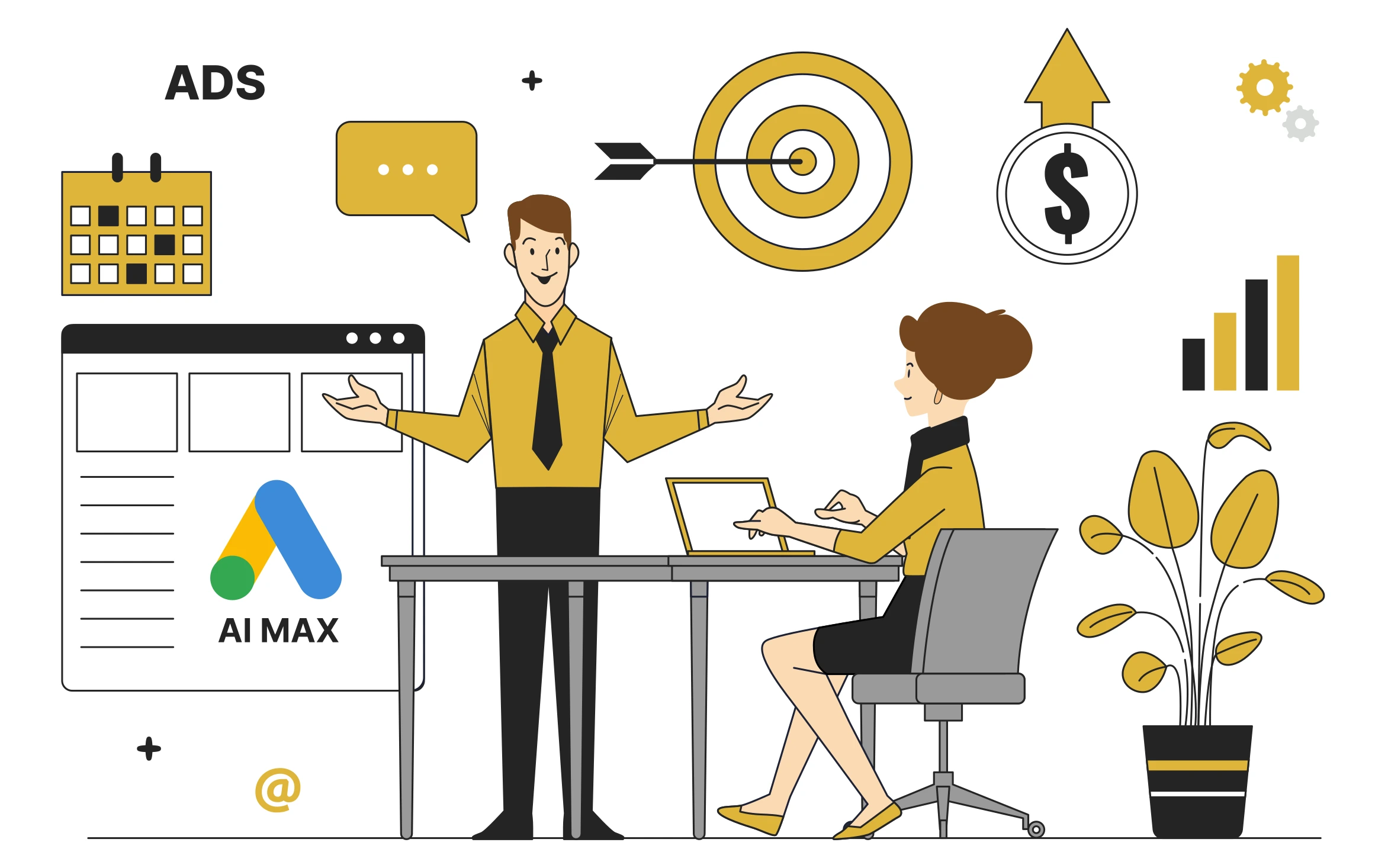
Google AI Max for Search campaigns automates ad matching, text generation, and URL optimization to boost performance in Google Ads. It promises efficiency and scale, but the road to results is bumpy.
This guide breaks down the real pain points businesses encounter, the six trends reshaping AI Max in 2026, and the core outcomes companies actually need.
TL;DR
- Google AI Max automates targeting, creatives, and landing pages, but often operates as a black box with limited transparency.
- Top challenges include loss of control, wasted budget from irrelevant matches, and dependency on Google’s ecosystem.
- 2026 brings agentic AI, predictive audiences, multimodal ads, and micro-intent targeting to search campaigns.
- Businesses need sustainable growth, full transparency, efficient customer acquisition, and future-proof strategies.
- AI-human hybrid oversight is becoming essential to balance automation with strategic control.
Here are the top 5 challenges:
Black-box opacity in AI decision-making for matching and optimization, leading to distrust and difficulty understanding why ads are served on certain terms.
AI Max makes decisions without showing its work. Advertisers can’t see why their ads triggered on specific queries or how the algorithm chose to expand targeting. This opacity breeds distrust. When you can’t explain to your boss why the budget went to certain terms, confidence erodes fast.
Loss of control over keyword targeting, creatives, and landing pages due to aggressive broad match expansion and automatic overrides like final URL expansion.
The system overrides your strategic choices. Broad match expansion pushes ads beyond your selected keywords, sometimes into irrelevant territory. Final URL expansion sends users to pages you didn’t specify. Your carefully crafted ad copy gets rewritten by AI. Control slips through your fingers like sand.
Inconsistent results and wasted budget from irrelevant query matches, with reports of up to 15% spend inefficiency despite promised reach boosts.
Efficiency promises don’t always materialize. Certain companies watch 15% of their spending disappear on searches that fail to convert. The AI chases volume without understanding business strategy or brand positioning. Learning periods can stretch 1-2 weeks with performance dips and inflated costs.
Limited transparency and reporting quirks, such as API errors when toggling features and challenges tracking AI-generated assets.
Reporting becomes a puzzle. API errors pop up when you adjust settings. You can’t correlate keywordless search terms across Google Ads for proper optimization. AI Max claims credit for conversions your exact match keywords already delivered. The data you need to make smart decisions stays hidden behind algorithmic curtains.
Dependency on Google’s ecosystem, stifling customization and innovation for advertisers needing precise oversight.
You’re locked into Google’s way of doing things. The system requires automated bidding strategies and won’t work with manual CPC. Regulated industries like finance, healthcare, and legal face compliance nightmares when AI generates unapproved messaging. Asset pinning gets ignored when certain features activate. Your ability to innovate within the platform shrinks.
2026 Trends Shaping Google AI Max
AI Max evolves rapidly. Here’s what’s next.
- Agentic AI evolution in AI Max autonomously handles audiences, bids, and creatives across Search, Display, Shopping, and YouTube.
The system is becoming self-directing. Agentic AI doesn’t just optimize within parameters you set; it makes strategic decisions across multiple campaign types without human input. It orchestrates your entire Google Ads presence, adjusting bids, selecting audiences, and generating creatives simultaneously across channels. The question becomes: who’s running your advertising, you or the algorithm?
- Rise of predictive audiences and lifecycle segmentation using first-party data to anticipate repurchases, upsells, or churn.
AI Max now predicts what customers will do next. By analyzing your first-party data, the system identifies who’s likely to repurchase, which customers are ripe for upselling, and who’s about to churn. Lifecycle segmentation moves beyond basic demographics to behavioral prediction. The focus shifts from acquisition to retention and lifetime value maximization.
- Multimodal AI ads integrating text, images, and behavior for intent prediction in AI Overviews and visual discovery like YouTube Shorts.
Advertising becomes multidimensional. The system combines text analysis, image recognition, and behavioral signals to predict user intent with unprecedented accuracy. Ads appear in AI Overviews and visual discovery platforms like YouTube Shorts. Search evolves beyond keywords into a creative canvas where users bring queries to life visually.
- Omnichannel ad continuity, with seamless experiences across devices and conversion fluidity beyond websites.
The customer journey fragments across touchpoints. AI Max creates continuity by recognizing users across devices and platforms. Conversions happen anywhere: on connected TVs, in apps, through voice assistants. The traditional website conversion model expands into a fluid, multi-device reality where “if they can see it, they should be able to buy it.”
- Increased AI-human hybrid oversight, pairing automation with strategic control amid rapid advancements.
Pure automation hits its limits. The industry recognizes that successful campaigns require human judgment paired with machine efficiency. Strategic oversight becomes the competitive advantage. Marketers focus on “why” and “what” while AI handles the “how.” Governance frameworks emerge to balance automation benefits with necessary brand protection.
- Shift to micro-intent targeting via conversational, voice, and visual search adaptations.
Search behavior becomes more exploratory and less keyword-focused. Users search with images, video, and natural language instead of typed phrases. AI Max adapts to conversational queries, voice searches, and visual discovery. The keyword era fades into a signal-driven targeting approach that captures micro-moments of intent across formats.
Client Needs More Than Clicks
Businesses crave outcomes that last.
Achieve sustainable revenue growth and higher ROAS through reliable, scalable customer acquisition beyond surface metrics.
Insignificant metrics don’t pay the bills. Businesses need predictable, profitable growth they can forecast and present to stakeholders. They want scalable customer acquisition that doesn’t just increase traffic but delivers actual revenue. Higher return on ad spend becomes the north star, measured by customers gained, not just clicks counted.
Gain full transparency and control to build trust in AI decisions, minimizing waste and aligning with brand standards.
Trust requires visibility. Companies need to understand why AI makes specific decisions so they can explain results confidently to bosses and clients. They want to minimize budget waste on irrelevant traffic while maintaining brand integrity. Control isn’t about micromanagement; it’s about strategic partnership with technology, not subjugation to it.
Unlock new high-intent customers efficiently, reducing acquisition costs while nurturing long-term loyalty.
Quality beats quantity every time. Businesses seek right-fit customers who convert and stick around, not tire-kickers who inflate metrics. Lower customer acquisition costs paired with higher lifetime value create a sustainable advantage. The goal shifts from capturing any conversion to building profitable, long-term relationships.
Adapt to complex consumer journeys with predictive, personalized engagement that drives repeat business and retention.
Modern buyers don’t follow linear paths. They research across devices, compare on social media, and convert through unexpected channels. Companies need advertising that adapts to this complexity with predictive insights and personalized messaging. Driving repeat business and reducing churn matter more than one-time wins.
Future-proof operations against platform dependencies, ensuring agility in a competitive, AI-driven landscape.
Nobody wants to be left behind. Businesses need marketing infrastructure that evolves with consumer behavior and platform changes. They seek resilience against constant algorithm updates and feature deprecations. The emotional need is security: knowing their investment won’t become obsolete tomorrow and their strategies will adapt to the AI-powered search landscape ahead.
Key Takeaways
- Google AI Max automates targeting, text, and URLs, but creates transparency challenges and control issues for advertisers.
- Main pain points include black-box decisions, aggressive expansions, budget waste, reporting limitations, and ecosystem lock-in.
- 2026 trends feature agentic AI, predictive audiences, multimodal formats, omnichannel continuity, hybrid oversight, and micro-intent targeting.
- Core business needs to focus on sustainable growth, transparency, quality customers, journey adaptation, and future-proofing.
- Success requires balancing automation’s efficiency with strategic human oversight and brand protection.
- The keyword era gives way to signal-driven, conversational, and visual search experiences.
Mastering AI Max starts with understanding these foundations. 2026 rewards the informed.
Comparison: Manual vs. AI Max
| Aspect | Manual Control | AI Max Automation |
| Targeting | Precise keyword selection | Broad match expansion |
| Creatives | Custom text and images | Auto-generated assets |
| Reporting | Full transparency | Limited insights |
| Strategy | Human-driven decisions | Algorithm-driven optimization |
| Learning | Immediate implementation | 1-2 week learning periods |
| Control | Complete oversight | Reduced advertiser control |
The choice isn’t either-or. Smart advertisers use both: manual campaigns for control and AI Max for expansion.
Ready to navigate Google AI Max with confidence? Explore Astha technology insights on PPC for more expert guidance on AI-driven advertising strategies.